Guardians of World Treasures Sign Salzburg Declaration on the Conservation and Preservation of Cultural Heritage

From an IMLS press release:

Washington, DC-On October 31, 2009, 59 cultural heritage leaders from 32 countries, including representatives of Africa, the Middle East, South America, and Asia, unanimously passed the Salzburg Declaration on the Conservation and Preservation of Cultural Heritage (http://www.imls.gov/pdf/Salzburg_Declaration%20.pdf). The declaration was the culmination of “Connecting to the World’s Collections: Making the Case for Conservation and Preservation of our Cultural Heritage,” the Salzburg Global Seminar (SGS) held October 28 – November 1, 2009 under the auspices of the U.S. federal Institute of Museum and Library Services (IMLS) and SGS. The declaration will be widely distributed to cultural ministries and other policymaking entities; it has already been translated into Arabic.

The seminar built on the findings of “Connecting to Collections: A Call to Action,” IMLS’s multi-year initiative on collections care, putting them into a global context. It combined presentations by leading experts in conservation and preservation throughout the world with small working groups tasked with making practical recommendations for future action on specific topics. Those guiding topics included emergency preparedness, education and training, public awareness, new preservation approaches, and assessment and planning. One evening was devoted to a fireside chat on “conservation in the developing world,” with a panel of participants representing Benin, Iraq, Mexico, Singapore, and Trinidad and Tobago.

At the opening session, Vinod Daniel, Seminar Co-leader and Head of Culture Heritage & Science Initiatives at the Australia Museum, noted that he had never attended a meeting “as diverse as this, with people from this many parts of the world, as cross-disciplinary as this.” A report summarizing the discussions and outlining the recommendations will be published later this year, sent to key stakeholders around the world, and made available online at www.imls.gov and www.salzburgglobal.org.

The Mummy Returns

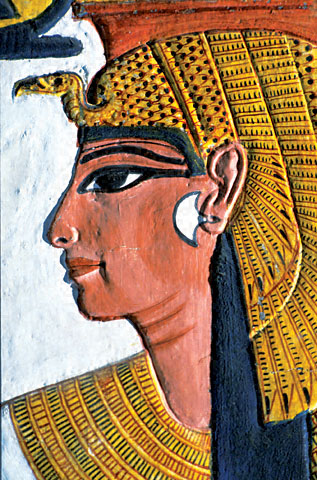
GCI and Egypt’s Supreme Council of Antiquities (SCA) are hooking up for a five-year collaboration to conserver King Tut’s tomb.

“King Tut has magic that we must conserve for future generations. I was happy when we CT scanned the mummy of King Tut in order to reveal the secrets of his family, but now I am even more thrilled to invite the Getty Conservation Institute to restore his tomb and return the glory of the boy king,” said Dr. Zahi Hawass, Secretary General of Egypt’s Supreme Council of Antiquities, and Vice-Minister of Culture. ” I am happy that the GCI will look at the tomb and preserve its beautiful scenes.”

Read more about the project on the Getty’s field projects page>>

Toby Raphael: 1951 – 2009

We are saddened to post the following press release regarding the passing of longtime AIC member Toby Raphael.

West Virginia Retired National Park Service Senior Conservator Toby Raphael Dies

SHEPHERDSTOWN, W.Va. – A jacket owned by Red Cloud. A dress worn by the Sioux war chief’s wife. Bear skin and lion skin rugs owned by Theodore Roosevelt. George Washington’s tent. John Brown’s Bible. Leather steamer trunks of immigrants passing through Ellis Island. Even advice on how to illuminate the Mona Lisa.

All of these, plus countless more artifacts – most in the care of America’s national parks and museums as well as those of nations across the world – have felt the hands and expertise of Toby Raphael, retired National Park Service senior conservator who died Wednesday at his home in Shepherdstown.

Raphael’s death at age 58 left his family and friends in shock. Survivors include his wife, Hali Taylor, head librarian at Shepherdstown Public Library, and sons, Jonathan, 23, of Boston and Seth, 26, of Monterey, Calif.

He was born in Hollywood in 1951, and graduated with double bachelor’s degrees in visual arts and Latin American studies from the University of California-San Diego in 1973, and a master’s degree in museum studies from George Washington University in 1977.

Until earlier this year, Raphael worked as a museum specialist at the National Museum of the American Indian in Washington, D.C. From 1978 to 2007, he held positions from museum specialist to senior conservator at the National Park Service’s Harpers Ferry Center in Charles Town, W.Va., work that had him crisscrossing the country from national park to national park throughout his NPS career conserving historic artifacts.

“I saw what Toby was doing and tried to follow in his footsteps,” said Susan Page of Takoma Park, Md., a senior paper conservator at The National Archives. “He had a good formula for success. Toby set the standard for conservation of museum objects.”

Considered by some experts to be the foremost leather conservator, Raphael wrote “Exhibition Conservation Guidelines,” a guidebook for use in the field “that affected conservation around the world,” said Theresa Voellinger, also an NPS paper conservator and colleague of Raphael’s. “It’s the first book of its kind to put organization on how we think about exhibits as a preservation method.”

Voellinger said Raphael traveled extensively in Central and South America as well, often at his own expense, to help Spanish-speaking conservators and historians working in small museums and institutions to protect and preserve their culture. He was fluent in Spanish.

“He taught me a lot about hands-on conservation and how to work with leather,” said Barbara Cumberland, an NPS objects conservator. “It was a privilege working with Toby all those years.”

Raphael’s specialty was Native American artifacts. He was also known for his finely worked leather purses.

On the personal side, Raphael enjoyed the companionship of a host of friends, social and professional. His son Seth spoke of his father’s penchant for always stepping up to help those in society’s lower stratum – the poor, the working class.

“I’ve never met anybody with a deeper interest in people,” said Bruce Dahlin of Shepherdstown, a longtime family friend.

“Toby was a magnet in drawing people out, caring and passionate about what he believed in. If you weren’t in his camp, he let you have it,” said Debi Taylor of San Diego, Raphael’s sister-in-law. “He inspired us to live a dream, to ask about life, and encouraged us to see and access more of it. He inspired so many people.”

Raphael’s death “was a real shocker,” Al Levitan, another NPS colleague and longtime friend, said in a telephone interview Thursday while on a trip with his wife, Jane, in Alabama. “It’s strange being away from the community at a time like this or to talk about Toby in the past tense. Toby left a legacy in his community and in the conservation world. He was a mentor to many. He will be missed by a wide range of people.”

Even recently, Raphael was volunteering with the Hispanic Outreach Services sponsored by St. Joseph’s Catholic Church in Martinsburg, W.Va., said Elizabeth McGowen of Shepherdstown, a fellow volunteer.

“Toby was my newest best friend,” McGowen said. “He was the sweetest, most generous person, a treasure, a pillar in the Shepherdstown community.”

Services will be Nov. 14 at 2 p.m. at the Presbyterian Meeting Hall, and followed by a pot luck reception at the Raphael Taylor home on Billmyer Road.

In lieu of flowers, donations may be made to the St. Joseph’s Catholic Church Hispanic outreach service program.

Culture Court

That nutty old Lawyers’ Committee for Cultural Preservation is sponsoring a moot court competition on national cultural heritage law at DePaul University. The web site reads:

This inaugural competition allows students the opportunity to advocate in the nuanced landscape of cultural heritage law. This dynamic and growing legal field deals with the issues that arise as our society comes to appreciate the important symbolic, historical and emotional role that cultural heritage plays in our lives. It encompasses several disparate areas: protection of archaeological sites; preservation of historic structures and the built environment; preservation of and respect for both the tangible and intangible indigenous cultural heritage; the international market in art works and antiquities; and recovery of stolen art works.

The problem for the inaugural competition will address criminal intent and statutory interpretation under the Archaeological Resources Protection Act. All rounds will be held in federal courtrooms in the Everett McKinley Dirksen United States Courthouse located in downtown Chicago. The judges for the final round will include members of the United States Court of Appeals for the Seventh Circuit.

Registration info is available on their site, or contact chmoot@depaul.edu

SGS Connect live blog

AIC and IIC member Richard McCoy did some interesting live-blogging from the Salzburg Global Seminar, Connecting to the World’s Collections: Making the Case for the Conservation and Preservation of our Cultural Heritage, on the IIC blog.

The veteran blogger’s posts – about one per day of the seminar – offer a combination of autobiographical musings, local history, conference review, philosophical questioning, and even a conservation song by Joyce Hill Stoner.

Well done!